Short answer: most retaining walls in the GTA cost $45–$110 per square foot of wall face installed in 2026. Segmental block walls sit toward the lower end. Armour stone and tall structural walls sit toward the top, and engineering for taller walls adds roughly $1,500–$4,000.
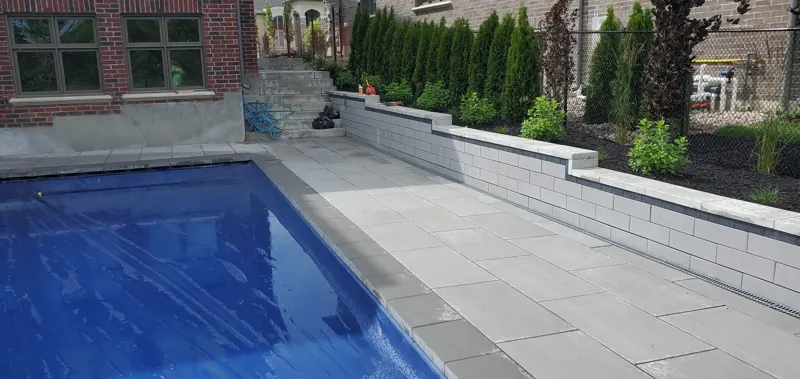
Typical prices at a glance
| Wall type | Typical range (per sq ft of face) |
|---|---|
| Segmental block garden or terrace wall | $45–$75 |
| Armour stone wall | $60–$110 |
| Tall structural or shoreline wall | $85–$120+ |
Wall face = length × exposed height. A wall 30 ft long and 3 ft high is 90 sq ft of face. These are market ranges from published GTA guides, not a quote.
Free tool
Retaining wall cost calculator
Enter length and height to see a typical price range and whether your wall likely needs a permit.
Open the wall calculatorWhy drainage is the most important line item
Retaining walls rarely fail because the block is weak. They fail because water builds up behind them, and in winter that saturated soil freezes and expands. A wall built to last has clear stone behind it, filter fabric to keep soil out of the stone, and a perforated pipe at the base that carries water away. If a quote doesn't mention drainage, ask.
Block vs armour stone
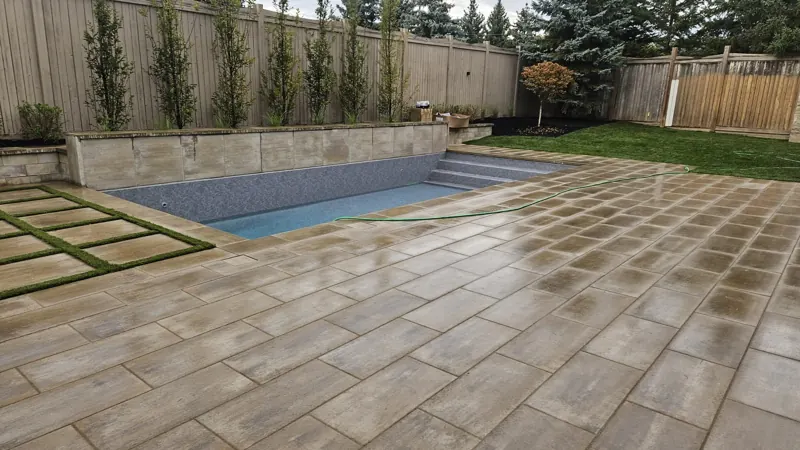
- Segmental block gives clean lines, curves, steps and caps. It's great for terraces, planters and seat walls.
- Armour stone is large quarried limestone placed by machine. It handles big grade changes, has a natural look, and suits ravine and sloped lots.
What armour stone costs, and why
Armour stone usually sits at the upper end of the $45–$110 per sq ft of wall face range, and the reasons are mostly physical. Each piece is a single quarried block, often several hundred kilograms to well over a tonne, so it is priced by weight and has to be trucked in and set one at a time with a machine. Three things move the number most:
- Stone size and grade: bigger, squarer stone holds more height per course but costs more per piece and per tonne delivered.
- Access: a backyard reached only through a narrow side yard means smaller equipment, more trips and more labour than a front yard with room for a loader.
- Height and setting: taller walls need deeper, wider footings, and walls over 1 m beside public property or a building access can need an engineer and a permit.
For a planter or a low terrace, segmental block often does the same job for less. Armour stone earns its price on big grade changes and wooded or ravine lots where a natural look matters.
When you need a permit or an engineer
Under the Ontario Building Code, a retaining wall more than 1 m (about 3.3 ft) in exposed height is a "designated structure" when it's next to public property, an access to a building, or private property the public is admitted to. Those walls need a building permit and a professional engineer's design. Lots near ravines or creeks may also need approval from Toronto's ravine by-law, TRCA or Credit Valley Conservation, even for smaller walls.
What moves the price
- Height. Taller walls need deeper footings, geogrid reinforcement and often an engineer.
- Access. Narrow side yards mean smaller machines and more hand work.
- Removal. Taking out an old timber or concrete wall adds cost.
- Material. Premium block and armour stone sizes vary widely in price.
FAQ
How long does a retaining wall last?
A properly drained block or armour stone wall can last for decades. Walls without drainage often start leaning within a few years.
Can you replace an old timber wall?
Yes. Rotting timber walls are common in older GTA neighbourhoods and are usually replaced with block or armour stone.