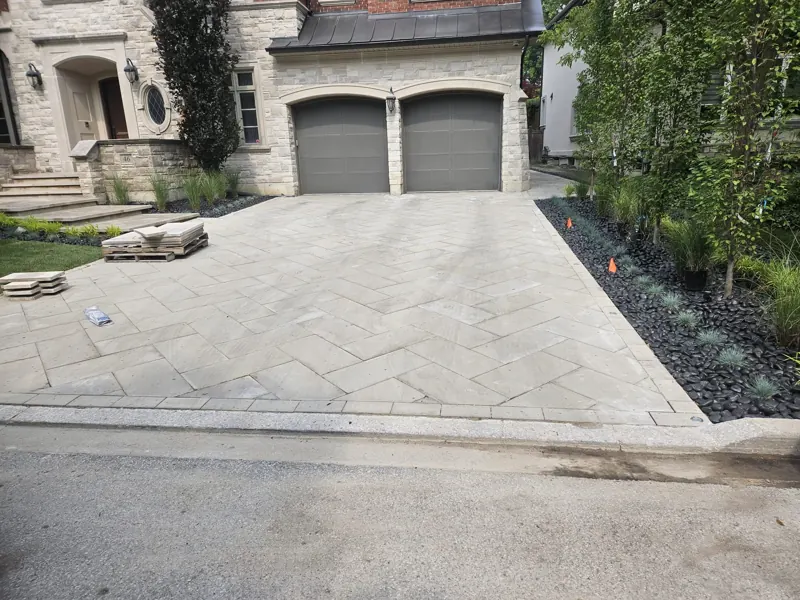
Weeds between pavers and washed-out joint sand
When the sand between pavers washes out, weeds and ants move in and the stones start to shift. Cleaning the joints out and refilling them fixes it before it turns into a relevelling job.
- 4.9 Google (17)
- Family-owned
- 15 years
- Free estimates
- Insured · WSIB
- 4.917 Google reviews
- 15years in business
- Familyowned and run
- InsuredWSIB covered
- Freeon-site estimates
Get a free interlock repair estimate in Mississauga
Tap your answers, leave a name and number, and a real person calls or texts you back within one business day.
Why weeds grow between pavers
Short answer: weeds don’t come up through a good base. They grow in the joints, in dust and seeds that settle where the joint sand has washed out. Empty joints also let pavers rock and drift, which is why a weedy driveway often starts to look uneven a few years later.
Joint sand is part of the structure. It is what makes separate pavers act as one surface, so losing it matters more than the weeds you can see.
Signs your joints need attention
- Grass or weeds in a line along the joints, coming back after you pull them.
- Small piles of fine sand next to the joints: ants are bringing it up.
- Joints you can see down into, or pavers that click or rock when you step on them.
- Dark streaks where water runs and washes the joints out, often below a downspout.
How we clean and re-sand the joints
- Clear the joints: weeds, roots, moss and old dirty sand come out, down to a clean joint.
- Check for movement: any rocking or sunken pavers get lifted and reset first, otherwise new sand only hides the problem.
- Refill the joints with jointing sand swept in and compacted into the joints, then topped up, so they are full to the right height.
- Clean the surface so no haze or loose sand is left on the pavers.
Polymeric jointing sand is installed on dry pavers in dry weather and needs time to cure, so we schedule it around the forecast rather than squeezing it in before rain. Doing it yourself? Read how to use polymeric sand.
When it needs more than new sand
If pavers have sunk, rutted or spread at the edges, re-sanding alone won’t fix it. That’s a relevelling job, where the pavers come up and the base underneath is corrected. We tell you which one you need when we look at it; see interlock repair for how relevelling works.
Keeping weeds out afterwards
- Point downspouts away from the paving, or into a drain, so water doesn’t wash the joints out.
- Sweep rather than pressure-wash close into the joints; a strong jet blows the sand out.
- Pull the odd weed early, before roots open the joint up again.
What homeowners say.
“Absolutely amazing job by the team. I love the result.”Danylo H. · Google review
“The guys are professionals, you can tell when people know what they’re doing.”Yurii A. · Google review
Questions, answered.
Why do weeds keep growing between my pavers?
The joint sand has washed out, so dust and seeds settle in the open joints and weeds root there. Pulling or spraying them only treats the top. Cleaning the joints out and refilling them with compacted jointing sand removes the space weeds grow in and locks the pavers again.
Is polymeric sand worth it between pavers?
For driveways and walkways, polymeric jointing sand usually holds up better against washout, weeds and ants than plain sand, because it firms up once it cures. It has to go onto dry pavers in dry weather and be cleaned off the surface properly, or it can leave a haze.
Will re-sanding fix pavers that move?
Only if the movement is small and comes from empty joints. If pavers have sunk, rutted or spread, the base underneath is the problem, and they need to be lifted and relevelled before the joints are refilled. We check which one you need before quoting.
Can I pressure-wash my interlock?
You can, gently. Keep the nozzle at an angle and back from the joints, because a strong jet blasts the joint sand out, which is what lets weeds and ants in. After a heavy wash the joints often need topping up with sand.
Tell us about your project.
Send the basics and a photo if you have one. A real person replies within one business day.
- 01We call or text back to understand the job.
- 02Free on-site visit to measure and check grades.
- 03A clear written quote. No pressure.